 |
 |
 |
|
| Fig. 122 | |
[Home] [Contents] [Figures] [Search] [Help]
[Next Page] [Prev Page] [ Next Chapter] [Prev Chapter]
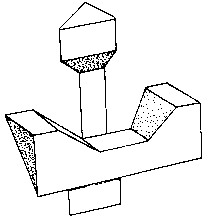
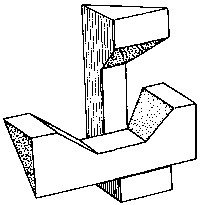
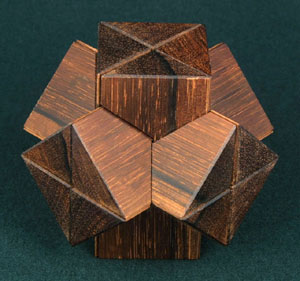
Now imagine each piece of the Square Prism Puzzle split in two longitudinally, resulting in 12 identical half-pieces. As an assembly puzzle, this additional dissection merely transforms it into more of a dexterity problem which is certainly not a step forward. But now join these half-pieces in perpendicular pairs - three right-handed and three left-handed. Now assemble! This amazing puzzle, shown in Fig. 122, with its six simple pieces has baffled experts. Even the name is a joke!
This puzzle was designed in 1973. Only about 200 have been produced, nearly all in mahogany. It is not difficult to make except that care is required to achieve an accurate fit, and stable woods must be used. The reader may wonder why it has not been mass-produced at low cost. Perhaps of injection-molded plastic, so that anyone may own one. That approach may not be such a good idea.
First of all there is no way that plastic can compete with wood aesthetically. Without arguing this point and the reasons for it, anyone who has sold handicrafts for a living knows that it is so. In toy manufacturing, the bottom line is usually profit and quarterly earnings, so puzzles are usually made of cheap styrene, warped by shrinkage, tapered slightly for easy ejection, and cored out to further reduce costs. To recover the investment in the mold, hundreds of thousands must be made exactly alike, whereas the designer-craftsman is always experimenting with variations and improvements. To reduce mold costs, compromises are made in design selection, especially avoiding those with all dissimilar pieces or requiring complicated moulds with side action. Also lost is the close rapport between designer and the public, when the manufacturer, jobber, and retailer all stand between. Perhaps some things, such as automobiles, are practical to manufacture only in large factories, but creative playthings crafted by hand are likely to bring more satisfaction to both maker and user.
| ©1990-2005 by Stewart T. Coffin For questions or comments regarding this site, contact the chief metagrobologist:  |
[Next Page] [Prev Page] [ Next Chapter] [Prev Chapter]