[Home] [Contents] [Figures] [Search] [Help]
[Next Page] [Prev Page] [ Next Chapter] [Prev Chapter]
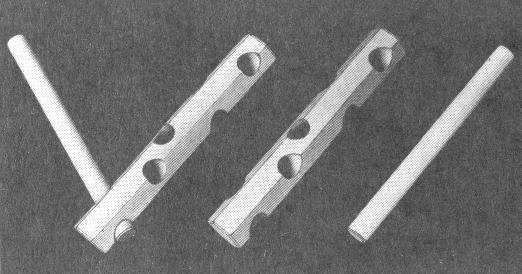
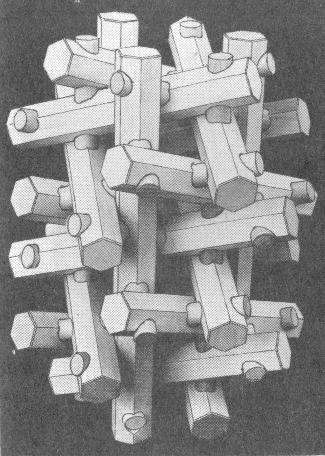
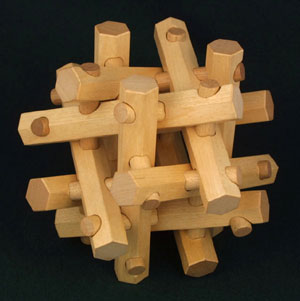
Refer back once again to the ubiquitous cluster of 12 triangular sticks in Fig. 93. For the sake of variety, reduce them from triangular to hexagonal cross-section. They will still rest flat against each other. To hold them together, drill five holes in each stick and pin them together with 12 dowels (Fig. 128).
Editor's Note: Stewart named this puzzle Locked Nest.
Fig. 128
Assembling this cluster of 12 hexagonal sticks and 12 dowels might be considered a puzzle of sorts - easy if an illustration is provided but perhaps not so easy otherwise. To make it into a more interesting puzzle, join some of the sticks and dowels to make elbow-shaped pieces (Fig. 129). The more elbows made, the harder the puzzle. With five elbows it is hard. With six elbows it is very hard. With seven, it is impossible.
Fig. 129
Hexagonal sticks are easily made by first ripping planed boards into sticks of rhombic cross-section with the saw tilted 30 degrees and then making two more cuts. All of the holes are spaced equally apart, are at the same 70½-degree angle to the axis of the stick, and are arranged in helical progression. Thus, a simple drilling set-up can be used that positions the stick using the previously drilled hole, with the stick being rotated 120 degrees in the same direction each time. The spacing of the holes can be determined by trial and error to achieve a snug fit. If they are too close together, the puzzle cannot be assembled. Spacing them farther apart simply makes a more open arrangement. With an open arrangement on a large scale, what a delightful and attractive climbing apparatus could be made for a children's playground.
This lattice structure repeats itself indefinitely in all directions, so one can make larger assemblies with more and longer sticks and dowels. From among the infinite variety of such constructions, one example is shown in Fig. 130a. It is basically two clusters joined together along their threefold axes.
Fig. 130a
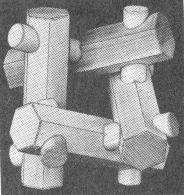
Another fascinating feature of this construction is that sub-units are also possible using fewer and shorter sticks and dowels. From among the many possibilities, one example is shown in Fig. 130b. It uses four sticks and four dowels, and each stick has three holes. As an assembly puzzle it would be rather too easy if given the illustration of the solution. However, this is easily corrected by joining one stick-dowel pair to make an elbow piece and another pair to make a cross piece. This construction might also be used to make a novel collapsible stand for a tabletop.
Fig. 130b
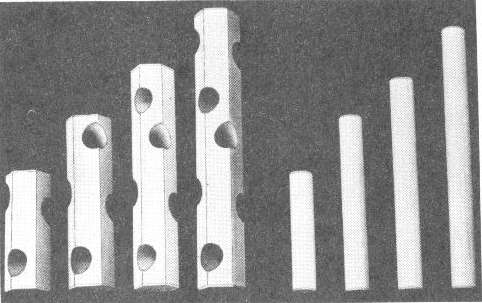
Yet another intriguing aspect of this system is its possibilities as a play construction set. Imagine having many sticks and dowels of each size from two-hole to five-hole and then discovering all the possible symmetrical constructions starting with the smallest and building upward. A few of these are shown in Fig. 131. What a marvelous plaything this might make for some curious youngster.
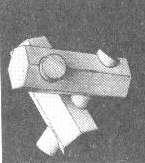
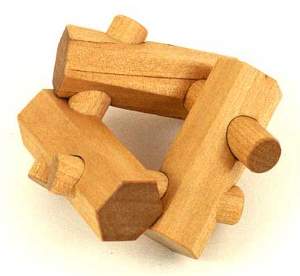
Fig. 131
The Cuckoo Nest Puzzle
A Triple Decker Puzzle
A Holey Hex Hybrid
Notched Hexagonal Sticks
Notched Rhombic Sticks
| ©1990-2005 by Stewart T. Coffin For questions or comments regarding this site, contact the chief metagrobologist:  |
[Next Page] [Prev Page] [ Next Chapter] [Prev Chapter]