[Home] [Contents] [Figures] [Search] [Help]
[Next Page] [Prev Page] [ Next Chapter] [Prev Chapter]
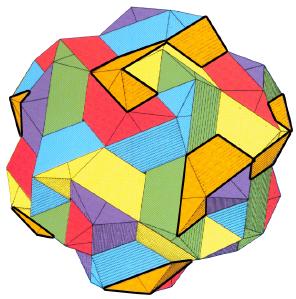
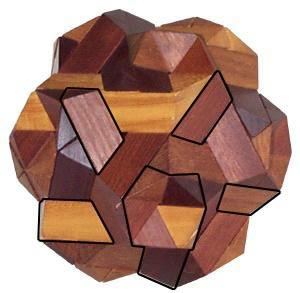
The triacontahedron can be completely enclosed by an arrangement of 30 sticks of 36-108-36-degree triangular cross-section, as was shown in Fig. 151. If these triangular sticks are split longitudinally into two identical halves and then joined in fives to make 12 identical, symmetrical puzzle pieces, an interlocking configuration is obtained that is directly analogous to the Scorpius Puzzle. It has six sliding axes, and the final step of assembly is the mating of two identical halves. This puzzle likewise has the tendency to fly apart when tossed into the air, even more so than the Scorpius. In the model shown in Fig. 157, the ends of the sticks are trimmed at an angle, giving it the appearance of a stellated triacontahedron with 30 faces. One puzzle piece is outlined.
Fig. 157
Note that for all of the polyhedral design shapes included in this book, only one view of the assembly need be shown. One just naturally and automatically assumes that the structure is symmetrical, so any additional views would only be redundant. This assumption of symmetry, consistency, congruence, repetition, predictability, or call it what you will, is so commonplace, not only in geometrical recreations but in all the arts and sciences, that we scarcely give it a thought. Yet where would we be without it!
This design, as illustrated in Fig. 157, lends itself well to color symmetry problems. Six colors are used, ten sticks of each color. Each puzzle piece has arms of five different colors, arranged in such a way that when correctly assembled, all like-colored sticks are in mutually parallel matched pairs, as indicated by the outlined orange pieces in Fig. 158. Four other solutions having color symmetry are then also possible, with a simple transformation from one to another. When well crafted of six dissimilar exotic woods, it is a fine specimen of woodcraft as well as a handsome geometrical sculpture. A puzzle of this sort was produced at one time with the name of Jupiter, and so for convenience it will be referred to by that name in what follows. (Reference: US Patent Des. 232,571 to Coffin, 1974.)
Fig. 158
A favorite theme of puzzle inventors is a device that looks deceptively simple to assemble but is actually quite difficult. The Jupiter Puzzle is an amusing example of just the contrary. Most persons will not even attempt to disassemble and reassemble this intriguing polyhedral dissection, so forbidding it looks; yet it is really quite easy. Years ago, when we worked the rounds of the craft fairs, I used to have one of these puzzles as the centerpiece of our display. When a crowd had gathered, I would toss it gently so that the pieces all fell in a heap. Then I would announce: "Anyone who can put it back together can have it!" Usually no one would try, especially not adults. Our youngest, then about age seven, would be planted in the crowd, and you can guess the rest. As she finished it with a bored look, tucked it under her arm and walked off, the crowd would finally realize that it had all been just a joke on them!
| ©1990-2005 by Stewart T. Coffin For questions or comments regarding this site, contact the chief metagrobologist:  |
[Next Page] [Prev Page] [ Next Chapter] [Prev Chapter]