[Home] [Contents] [Figures] [Search] [Help]
[Next Page] [Prev Page] [ Next Chapter] [Prev Chapter]
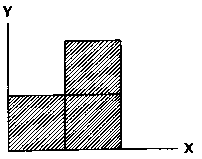
Shown in Fig. 173a is a portion of a checkerboard dissection with x, y coordinates added. Any single square may now be designated by its x, y coordinates, and any puzzle piece by a group of such squares. Thus, the shaded piece is 1,1; 2,1; 2,2.
Fig. 173a
Given this notation (or some other of your liking), pieces may be moved about, rotated, turned over, fitted together, etc., all with numbers alone and with no need for the physical pieces or even drawings of them. This dimensionless world of numbers is of course the only world known to electronic computers. All puzzle problems must be reduced to it before being fed in, and any geometrical figures desired must be reconstructed after digestion and disgorgement by the computer.
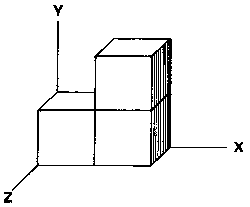
It is easy to add a third dimension to this scheme and thereby use it to describe polycube puzzles. The puzzle piece shown in Fig. 173b would then be described in x, y, z coordinates as 1,1,1; 2,1,1; 2,2,1.
Fig173b
Such pieces may likewise be moved about and assembled analytically. Now the question arises, given the geometrical model and its numerical representation, which is the real puzzle and which is the abstraction? To pursue that question, consider the case of higher dimensions. This numerical notation works equally well in any dimension. A three-block piece in four dimensions - w, x, y, z - might be represented by 1,1,1,1; 1,1,1,2; 1,1,2,2. Note that each square in two dimensions is adjacent to four others, represented by adding or subtracting one from any one coordinate. Likewise a cube in three dimensions is adjacent to six others, a block in four dimensions to eight others, and so on. Such higher dimension pieces may likewise be moved about and assembled into solid symmetrical solutions. The intriguing question of determining what would be considered "interlocking" or "assemblable" in four or more dimensions is left to the reader.
Now, which is the reality - numbers that we can understand (perhaps) and easily manipulate or hopelessly unimaginable hyper-geometrical models? Some Greek mathematicians, Pythagoras especially, were said to have regarded pure numbers alone as the ultimate reality in the universe and everything else as a state of mind. Modern knowledge in neurophysiology and computer science casts this profound idea in a new light. Recent developments in theoretical physics go even farther into the abstract world of numbers, where physical models actually become utterly meaningless. Perhaps more to the point, what do the terms physical and abstract really mean, if anything?
| ©1990-2005 by Stewart T. Coffin For questions or comments regarding this site, contact the chief metagrobologist:  |
[Next Page] [Prev Page] [ Next Chapter] [Prev Chapter]