 |
 |
| Fig. 6a | Fig. 6b |
[Home] [Contents] [Figures] [Search] [Help]
[Next Page] [Prev Page] [ Next Chapter] [Prev Chapter]
If, instead of cutting freely, the dissection is done according to some simple geometrical plan, an entirely different type of puzzle results. Many fewer pieces are required to create interesting puzzle problems. Three characteristics of such puzzles are that they nearly always use straight line cuts, they usually assemble into many different puzzle shapes, and the problem shapes often have more than one solution.
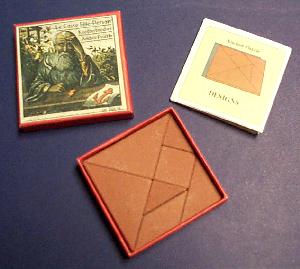
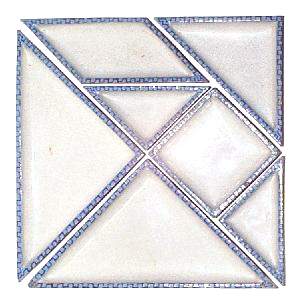
Of the types of puzzles covered in this book, the oldest known is the popular seven-piece dissection of the square known as Tangram. It was at one time thought to be thousands of years old, but is now known to have originated in China sometime before 1780. (A quite similar Japanese seven-piece square dissection has been dated back to 1742.) Tangram became popular throughout Europe and America in the 19th century and continues to be so to this day. It is made and sold in many different materials. Thousands of problem shapes have been published for it over the years, and it is mentioned in many books. For more background information on Tangram and many similar puzzles, the reader is referred to Puzzles Old and New by Botermans and Slocum. Here we will discuss some of the curious mathematical aspects of the puzzle not generally mentioned in the literature. The dissection is shown in Fig. 6a and 6b. Fig. 6a is a reproduction by the German firm Richter and Co. of a Tangram set originally produced by them in the 1890s. Richter was well known for their Anchor Stone Building Sets. They called it Der Kopfzerbrecher which translates to "The Head Cracker". Fig. 6b is a set of Chinese candy dishes made around 1860 in China.
In designing dissection puzzles of this type, the idea is to divide the whole according
to some simple geometrical plan so that the pieces will fit together many different ways.
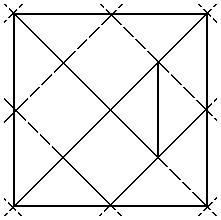
The way this is accomplished in Tangram is shown in Fig. 7. A diagonal square grid is
superimposed onto the square whole such that the diagonal of the square measures four
units and the area is eight square units. The only lines of dissection allowed are those
that follow the grid or diagonals of the grid. To put it another way, the basic structural
unit is an isosceles right-angled triangle made by bisecting a grid square, and all larger
puzzle pieces are composed of these unit triangles joined together different ways. In
Tangram, there are two of the unit triangles alone, three pieces made up of two unit
triangles joined all possible ways, and two large triangles made up of four unit
triangles, for a total of 16 unit triangles. The relative lengths of all edges are thus
powers of  .
.
Fig. 7
The first Tangram problem is to scatter the pieces and then reassemble the square. Note that it has only one solution, usually a mark of good design. (Rotations and reflections are not counted as separate solutions.) For the countless other problem shapes, you can try to solve the published ones found in many books and magazines or you can invent your own.
The easiest way to discover Tangram patterns is just by playing around with the pieces. Start by trying to make the simplest and most obvious geometrical shapes - triangle, rectangle, trapezoid parallelogram, and so on, always using all of the pieces. An alternate method is to draw some simple shape on graph paper following the rules already given and having an area of eight squares, and then try to solve it. Which of the examples shown in Fig. 8 are possible to construct?
Fig. 8
Published Tangram patterns range all the way from the geometrical shapes shown above to the other extreme of animated figures created by arranging the pieces artistically. This range is represented by the row of figures shown in Fig. 9, reading left to right. Only those solutions that conform to a regular grid can be considered true geometrical constructions. Careful inspection will show those to be the three on the left. The others may be very artistic and imaginative, but they are not within the province of this book.
Fig. 9
The theme of discrete rather than random or incommensurable ratios of dimensions is one that plays continuously in the background throughout this book. In the case of Tangram-like dissection puzzles, it is easy to see that they cannot be made to work properly any other way. Beyond that, though, there must be something inherently appealing to our aesthetic sensibilities in simple, discrete ratios. They are, after all, the foundation of all music, although probably no one understands exactly why.
Fig. 10 shows 13 convex Tangram pattern problems. A convex pattern is one that can be cut out with a paper cutter straight away, i.e. with no holes or inside corners. They are all possible to construct. Are any others possible?
Fig. 10
For a slight change of pace from the usual Tangram problem, consider the following puzzler, which by the way is based more or less on an actual happenstance: Karl Essley made two Tangram sets as gifts - one to be sent to his sister and the other to his brother. The instructions were simply to assemble all the pieces into a square. Karl's sister brought hers back and declared (correctly) that the solution was impossible. Examining her set, they discovered that Karl had made a mistake in packing and had accidentally put two pieces into the wrong box, so one person got a set of five pieces and the other got nine. Embarrassed, Karl suggested that they phone their brother and explain the mistake. But his sister reflected for a moment and then said, "No that won't be necessary - he can make a square with his set." Can you tell who got the two extra pieces and what shape or shapes they were? (Answer) Be careful - this puzzler contains a nasty trap.
In a similar vein to the above puzzler, note the pairs of figures shown in Fig. 11. In each pair, one figure appears to be complete and the other appears to have a piece missing; yet they both use all seven pieces, as all Tangram figures must. Can you discover the common characteristic that all such confusing pairs have? (Answer) What other such pairs can you discover?
Fig. 11
In order to be entirely satisfactory, especially considering the examples just given, even simple puzzles such as this one should be accurately made of stable materials. If sawn directly out of a square of plywood, there will be noticeable errors introduced by the saw kerf. A more accurate way is to lay it out on cardboard, cut the cardboard with scissors, and then use the cardboard pieces as patterns.
Throughout this book, unscaled drawings are given for puzzle constructions. There are always a few readers who will report being unable to use such drawings, having been indoctrinated in school with the notion that nothing can be made out of wood without standard workshop blueprints with dimensions. Dimensions are omitted for the following reasons:
| 1. | They are unnecessary. It should be obvious for example that in Tangram all of the angles are 45 or 90 degrees. |
| 2. | They are not as accurate as geometrical constructions. If the overall Tangram square is integral, all of the diagonal measurements are irrational and can be expressed in sixteenths of an inch or whatever only by rounding off. |
| 3. | Adding practical dimensions would only tend to obscure the elegantly discrete mathematical essence of the problem with unessential detail. |
| 4. | You may scale the puzzle to any size you wish. |
| ©1990-2005 by Stewart T. Coffin For questions or comments regarding this site, contact the chief metagrobologist:  |
[Next Page] [Prev Page] [ Next Chapter] [Prev Chapter]