[Home] [Contents] [Figures] [Search] [Help]
[Next Page] [Prev Page] [ Next Chapter] [Prev Chapter]
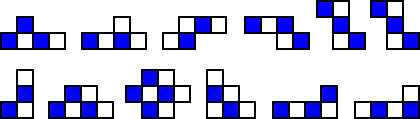
Checkerboard puzzles consist of a dissected standard 8 x 8 checkerboard (draughtsboard). The object is not only to reassemble the pieces into an 8 x 8 square, but to do so with the proper checkering. A Compendium of Checkerboard Puzzles compiled by Jerry Slocum in 1983 lists 33 different versions, and it includes only those that have been manufactured, patented, or published. The numbers of pieces range from 8 to 15, with 12, 13, and 14 being the most common. The oldest is dated 1880. The commercial versions were usually made of die-cut cardboard printed on one side only, so the pieces may not be flipped. Some are printed on both sides, and the checkering may not be the same on both sides. Those made of light and dark wooden squares can of course be flipped. A typical 12-piece dissection taken from Slocum's Compendium is shown in Fig. 22. The pieces may not be flipped. It is known to have at least two solutions.
Fig. 22
Taken as a whole, checkerboard dissections tend not to be the most inspired of puzzle designs. All that can be said for most of them is that they differ slightly from each other. Any reader wishing to make a checkerboard dissection puzzle might just as well create an original design rather than copy someone else's. Here are some design suggestions:
| 1. | As the number of pieces is increased, the difficulty increases, reaches a maximum, and then diminishes. For the checkerboard, maximum difficulty occurs around 11 or 12 pieces. |
| 2. | Difficulty of finding one solution varies inversely with the number of solutions possible. Designs with only one solution are considered especially clever (but how do you know?) |
| 3. | Pieces with compact shapes approximating square or rectangular, such as those containing a 2 x 2 square lend themselves more easily to solutions and increase the number of solutions. Contrarily, skinny, angular, complicated shapes do just the opposite, especially those that refuse to fit into corners. |
| 4. | To be avoided are pieces having rotational symmetry, and especially pieces identical to each other. (There will be more on this later. For a simple explanation here, imagine a checkerboard dissection in which this rule is grossly violated and see how exceedingly uninteresting it would be.) |
It is interesting to note that the additional constraint imposed by the checkering may make the solution (or solutions) easier or harder, depending upon the circumstances. If only one mechanical solution exists to begin with, obviously the checkering makes it much easier to find. On the other hand, if hundreds of solutions exist, but only one with the correct checkering, then the addition of the checkering has turned it into a real puzzler!
| ©1990-2005 by Stewart T. Coffin For questions or comments regarding this site, contact the chief metagrobologist:  |
[Next Page] [Prev Page] [ Next Chapter] [Prev Chapter]