[Home] [Contents] [Figures] [Search] [Help]
[Next Page] [Prev Page] [ Next Chapter] [Prev Chapter]
To mathematicians, the term geometrical dissection has a slightly different meaning from the one we have been using here. It usually refers to two different polygons being formed from the same set of pieces. This is essentially an analytical problem, and a minor branch of mathematics is devoted to it. It has been proven that any polygon can be dissected to form any other polygon of the same area. Most attention has been given to the regular polygons. Choose my two regular polygons, and cut one of them into as many pieces as you wish to form the other. It may sound easy until you actually try it!
The classic problem in geometrical dissections is to find the minimum number of pieces required to perform a dissection between various pairs of common polygons. An excellent book on the subject is Recreational Problems in Geometrical Dissections and How to Solve Them, by Harry Lindgren.
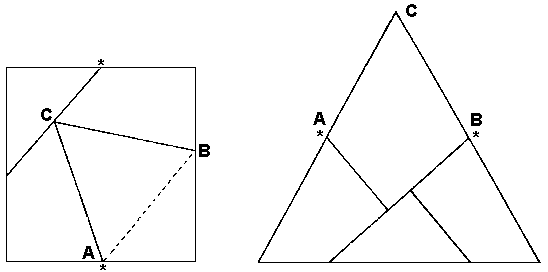
Famous puzzle inventor Henry Dudeney was a pioneer in geometrical dissections. His classic four-piece dissection between the square and equilateral triangle, first published in 1902, is shown in Fig. 21. This must be the simplest of all possible dissections between two regular polygons. Yet if the reader will try to construct the dissection, even after glancing at the drawing, it will immediately obvious that the methods described earlier in this chapter do not work!
Fig. 21
Start by constructing a square and equilateral triangle of equal area. Thus, if the
square is 1 x 1, the sides of the triangle are  .
Next, note that all points marked (*) are midpoints of sides. Therefore, triangle ABC is
equilateral and point B on the square is located by measuring
.
Next, note that all points marked (*) are midpoints of sides. Therefore, triangle ABC is
equilateral and point B on the square is located by measuring  from point A, after which the rest is obvious.
In geometrical recreations of this sort the essence of the puzzle is discovering the dissection. Given the dissections, their physical embodiment in the form of actual puzzle pieces has never enjoyed much popularity as practical manipulative puzzles. Perhaps it is because the two solutions are quickly memorized, and then there are no more problems. But there are exceptions. The Sam Loyd dissection puzzle described in the previous section was most likely developed by dissecting the square into the cross, after which the other interesting problem shapes were probably discovered. Creative Puzzles of the World, by van Delft and Botermans, contains an excellent chapter on geometrical dissections as practical puzzles. Further investigation might uncover a dissection by which several polygons could be constructed from a neat set of pieces. For example, what are the fewest pieces required to construct three different regular polygons? (Answer unknown, at least to the author.)
| ©1990-2005 by Stewart T. Coffin For questions or comments regarding this site, contact the chief metagrobologist:  |
[Next Page] [Prev Page] [ Next Chapter] [Prev Chapter]