[Home] [Contents] [Figures] [Search] [Help]
[Next Page] [Prev Page] [ Next Chapter] [Prev Chapter]
So far we have discussed only burrs with no internal voids. Historically, solid burrs have received the most attention. No satisfactory explanation has ever been given for this, but perhaps it is simply the notion that many things in life tend to be more satisfying when they are solid - building foundations, financial investments, friendships, and so on. Also, Bill Cutler points out that only by limiting his program to solid burrs was the analysis practical as otherwise the computation time would have been too long. (Editor's Note: This is no longer true. See the previous note on this subject.) The recent flurry of activity in designing ever more entertaining (meaning, to some, fiendishly difficult) burrs has shifted attention to burrs that do not come directly apart (or go directly together) but rather involve the shifting back and forth of pieces or groups of pieces within the partially assembled burr. Some of these are so baffling as to discourage a professional locksmith yet they are basically just standard burrs using the 837 practical pieces. They all necessarily have one or more internal voids.
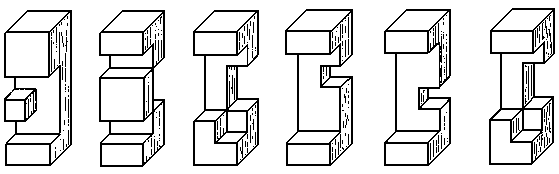
One of the best of this new breed of burrs is Bill's Baffling Burr, designed of course by Cutler. It uses two unnotchable pieces, both of which are easily made from notchable pieces by gluing in one and two extra blocks. It has seven internal voids. This is an unusually large number of voids for a burr with only one solution, and contributes to its difficulty, for there are 24 apparent solutions but only one that is possible to assemble. Thus, you may think you have found the solution and are wondering how to get the last piece in place when most likely you have stumbled upon one of the 23 false solutions. It was stated earlier that the pieces could be of arbitrary length. With some of these more complicated burrs, this is no longer true. Bill's Baffling Burr (Fig. 70) cannot be assembled if the pieces are longer than three times their width.
Fig. 70
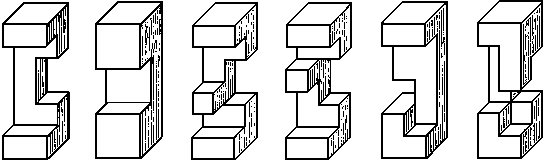
Bill's Baffling Burr is referred to as a level-five burr, meaning that five separate shifts are required to release the first piece. This new yardstick of devilry has spurred some rivalry among puzzle experts to see who can come up with even higher level burrs. Around 1985, Gaby Games of Israel came out with an amazing level-seven-four burr, meaning that seven moves are required to release the first piece and four more are required to release the second piece. Would someone next discover a level-eight burr? Well, not exactly. Recently Peter Marineau surprised the puzzle world with a level-nine burr! Is this the upper limit? Probably not. The Marineau burr, shown in Fig. 71 achieves its remarkable stunt with surprisingly simple pieces. Two are identical, another two are a reflexive pair, and another one is self-reflexive.
Fig. 71
Perhaps the reader will now be encouraged to wander off into this vast wilderness of hidden notches and explore some of them further. For the puzzle connoisseur, a well-crafted six-piece burr is the embodiment of good design - simple, direct, and eminently functional. For the hobbyist, the burr is well suited for a workshop project and helpful woodworking tips are given later. In particular, the would-be puzzle inventor will find much to explore beneath the deceptively familiar exterior of the six-piece burr.
Considering the large number of possible assemblable sets of the 837 practical pieces, recently estimated by Cutler to almost certainly exceed one billion, any one of them chosen at random is likely to be a new and original, but totally uninspired, design. The first step, then, is to decide just what features one considers most desirable. A few guide-lines have been suggested here, but there may be other, better ideas that have been overlooked. Originality, psychology, and aesthetics all play a role at this stage of the creative process. The second step is seeking the combination that best achieves one's goal, and this is essentially an analytical and mechanical problem.
Imagine a computer being programmed to methodically print out all of the probably billions of assemblable standard six-piece burrs. All but a handful would be new and original designs - or would they? Does merely being different constitute originality? There is a curious musical analogy. With conventional discrete musical notation, one could, in theory at least, program a computer to print out every possible musical theme, given enough time and unlimited supply of paper. Buried within this mountain of papers would be all of the most sublime works of the great masters of the past and of those perhaps to come in the next Renaissance. But then how could they be found from amongst the random noise? The whole exercise would amount to nothing.
Trying to improve upon an existing burr design can be an enlightening exercise. For example, as a maker of puzzles, one is always trying to reduce the number of unnotchable pieces. Moving or removing just one offending unit block seems innocent enough, but it nearly always causes havoc. Attempts to correct the problem just create more problems. (Sounds familiar?) Sometimes you work through a loop of changes and end up back where you started. It is slow work for every new change requires an analysis of all possible solutions. Some analysts use a computer for this. It does in seconds what otherwise might take hours or even days. Others not in such a rush may enjoy the mental exercise in traditional methods of analysis using pencil and paper. For them, the analysis is the puzzle so why not relax and enjoy it?
| ©1990-2005 by Stewart T. Coffin For questions or comments regarding this site, contact the chief metagrobologist:  |
[Next Page] [Prev Page] [ Next Chapter] [Prev Chapter]