 |
 |
| Fig. 145 | |
[Home] [Contents] [Figures] [Search] [Help]
[Next Page] [Prev Page] [ Next Chapter] [Prev Chapter]
Now to the other extreme! It has already been shown that polyhedral puzzles need not have many pieces to be interesting and even challenging. The confusing Three-Piece Block Puzzle speaks for itself. The fewest pieces an assembly puzzle can have is, by definition, two. Is it possible to create an interesting assembly puzzle of just two pieces?
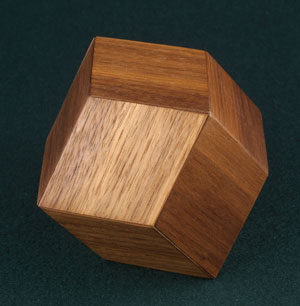
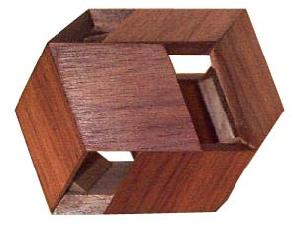
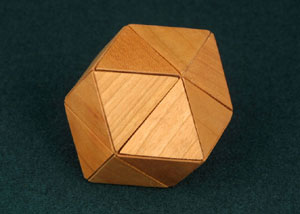
When our three children were quite small, they used to spend hours in my workshop patiently gluing together little scraps of fancy woods to make "puzzles" for their friends. One time we had a surplus of truncated rhombic pyramid blocks which they industriously glued together all different ways. What emerged from this was a simple two-piece dissection of the rhombic dodecahedron (Fig. 145). It has two mirror-image halves made of six blocks each that fit together with no difficulty whatsoever. It is when you try to take it apart that the fun begins. If made carefully so that the division of the two halves does not show, nearly everyone will grasp randomly with thumb and forefinger of each hand on opposite faces and pull. But when you do that, you will always be holding both pieces in each hand, and it will never come apart. Only when one uses an unnatural three-finger grasp with each hand and then hunts randomly for the one sliding axis will it come apart with ease!
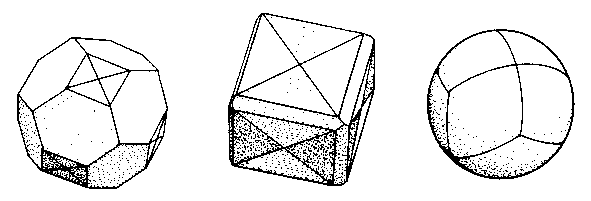
We made and sold these for a few years. The kids used to put a penny inside, hence the name. I think they used up all the scraps and got interested in other things at about the same time, and production ceased. We tinkered with many variations. The only limit here is your imagination. There are truncated and stellated versions, rounded, three-piece, and multicolored ones. There are nesting sets in which each one is different. A few random samples are shown in Fig. 146.
Fig. 146
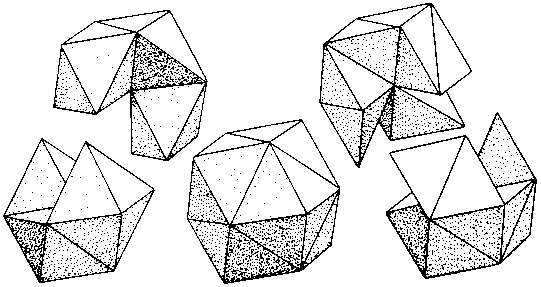
One of the most amusing and confusing versions was a matched set of two Pennyhedrons - each one made of 24 tetrahedral blocks, as shown in Fig. 147. One of these is the standard Pennyhedron that comes apart with the tricky three-finger grasp. The other one, which looks exactly the same, comes apart easily along a fourfold axis of symmetry with the common thumb-and-forefinger grasp. Naturally the kids could do the tricky one, but the easy one had them completely baffled! (We will be seeing this dissection again in Chapter 21.)
 |
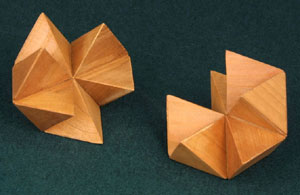 |
Fig. 147
| ©1990-2005 by Stewart T. Coffin For questions or comments regarding this site, contact the chief metagrobologist:  |
[Next Page] [Prev Page] [ Next Chapter] [Prev Chapter]