[Home] [Contents] [Figures] [Search] [Help]
[Next Page] [Prev Page] [ Next Chapter] [Prev Chapter]
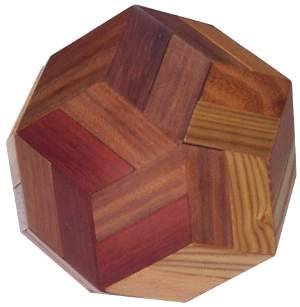
The 24-piece dissection of the rhombic dodecahedron in Chapter 15 leads by analogy to a 60-piece dissection of the triacontahedron, as shown in Fig. 162. John Loeser has arrived at the data given in Table 5 for the possible ways of joining such blocks into different puzzle pieces, up to size-six.
Fig. 162
Table 5
Of the 54 pieces of size-six, 45 of them are considered by us to be practical usable pieces. From among those 45, we have searched long and hard for a practical assemblable subset of 10 such pieces. So far, none has been found and it appears that perhaps none exists. But with some 20 billion different ways of choosing subsets of 10 from a set of 45, the possibility exists that we may have overlooked one! The example shown in Fig. 162 is randomly dissected simply to illustrate the principle rather than any practical solution.
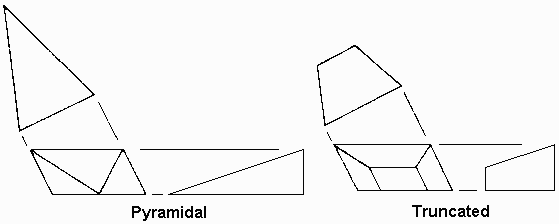
Like those of the rhombic dodecahedron in Chapter 15, these individual blocks are fairly easy to make. They are sawn from 18-72-90-degree triangular cross-section stock using the same techniques. Much wood and some labor can be saved by using trapezoidal rather than triangular stock, as shown in Fig. 163, thus making the center of the puzzle hollow. The blocks are fairly easy to assemble and glue using tape and rubber bands to hold them in place. Considering the complexities and the failure to find a practical design, the potential for this dissection probably is not as an assembly puzzle but more as a geometrical sculpture, especially using multicolored exotic woods.
Fig. 163
| ©1990-2005 by Stewart T. Coffin For questions or comments regarding this site, contact the chief metagrobologist:  |
[Next Page] [Prev Page] [ Next Chapter] [Prev Chapter]