 |
 |
 |
|
| Fig. 141 | |
[Home] [Contents] [Figures] [Search] [Help]
[Next Page] [Prev Page] [ Next Chapter] [Prev Chapter]
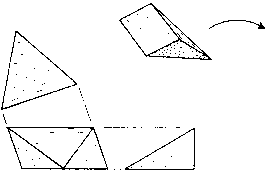
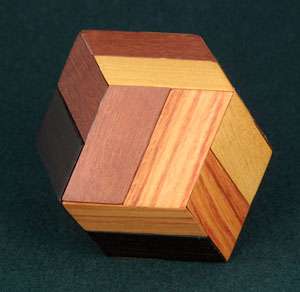
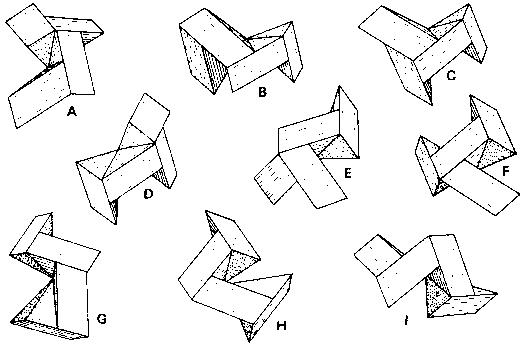
Chapter 9, Fig. 113 shows a rhombic dodecahedron dissected into 12 rhombic pyramids. In the model shown in Fig. 141, each rhombic pyramid is further divided into two identical halves that could be regarded as skewed rhomboid pyramids or triangular stick segments. Not counting side-by-side pairs, there are 10 different ways of joining four such blocks together, analogous to those of the Scrambled Scorpius Puzzle. Nine of these are non-symmetrical and are illustrated in Fig. 141.
Editor's Note: Stewart named this puzzle The Garnet Puzzle.
Problem: from this set of nine pieces, find subsets of six that assemble into the rhombic dodecahedron. Two such subsets are known, and there are probably no others. Either subset makes a satisfactory interlocking puzzle with only one solution and one sliding axis. Five of the pieces are common to both subsets, so an especially interesting version of the puzzle is a set of seven pieces that will construct either solution with one piece set aside.
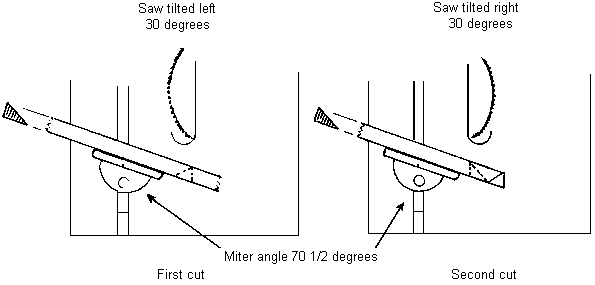
Since this is a fairly easy puzzle to make, the reader is encouraged to do so and discover these two solutions or perhaps experiment with other sizes of pieces and new combinations. The 24 blocks are sawn from 30-60-90-degree triangular cross-section sticks as shown in Fig. 142. If sawn accurately, they tend to align themselves properly when clustered together and held with rubber bands and tape. The desired joints are then glued selectively, one at a time. The finished puzzle, well waxed and with one piece removed, can then be used as a gluing jig for the next one.
Fig. 142
Since the assembled shape of this puzzle is entirely convex, fancy woods can be used and brought to a fine finish by sanding and polishing the 12 outside faces. In combinatorial puzzles of this sort, the addition of multicolor symmetry to an already satisfactory puzzle tends to defeat its purpose. Instead, an attractive random mosaic effect is obtained by making each puzzle piece of a different wood in contrasting colors.
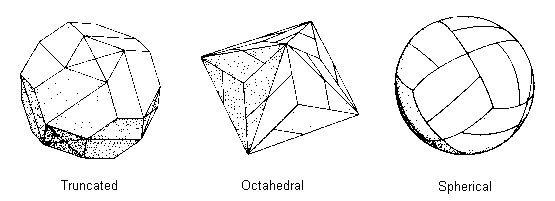
Note also that this is one of the few designs in which all the planes of dissection pass through the center of the puzzle. Consequently, the assembled puzzle can be truncated or rounded down to various sculptural shapes (Fig. 143), making interesting and sometimes surprising patterns in the multicolored versions. By the same token, the assembled puzzle can be either solid or hollow inside.
Fig. 143
Two-Tiered Puzzles
The Pennyhedron Puzzle
| ©1990-2005 by Stewart T. Coffin For questions or comments regarding this site, contact the chief metagrobologist:  |
[Next Page] [Prev Page] [ Next Chapter] [Prev Chapter]