[Home] [Contents] [Figures] [Search] [Help]
[Next Page] [Prev Page] [ Next Chapter] [Prev Chapter]
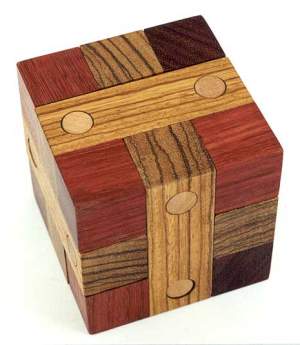
The Pin-Hole Puzzle has an interesting variation. Eight cubic blocks are added to the corners of the Pin-Hole Puzzle, making the assembled shape cubic (Fig. 82a).
Fig. 82a
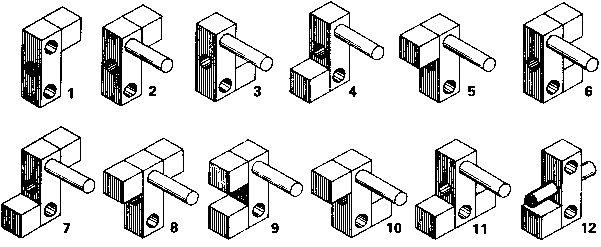
Each cubic block might be attached to any one of the three bars against which it rests. Thus, the puzzle designer faces a choice of 38 or 6,561 different ways of attaching the blocks. Another way of looking at the problem is to consider all the different types of pieces that could result. When one considers all the ways that one or two blocks can be added to the three basic pieces (bar, cross, elbow), there are 18 possible augmented pieces. Six of these are less desirable because they have an axis of symmetry, leaving the 12 pieces shown in Fig. 82b. Problem: from this set of 12 pieces, find a subset of six pieces that assembles one way only. The author has tinkered with this problem off and on for years without success. For some reason not understood, the solutions always seem to occur in pairs or more. To simplify the problem somewhat, note that piece 1 must always be used, plus three more pieces with single blocks and two with double blocks. Thus, there are 150 possible subsets.
Fig. 82b
Here is one fairly satisfactory combination with a pair of solutions: pieces 1, 2, 3, 7, 8, and 12. Can the reader improve upon this? The Pin-Hole Puzzle and Corner Block Puzzle are not really burrs. They sneaked into this chapter as close relatives. This theme is carried forward in Chapter 13 and Chapter 22.
| ©1990-2005 by Stewart T. Coffin For questions or comments regarding this site, contact the chief metagrobologist:  |
[Next Page] [Prev Page] [ Next Chapter] [Prev Chapter]