[Home] [Contents] [Figures] [Search] [Help]
[Next Page] [Prev Page] [ Next Chapter] [Prev Chapter]
Most of us have at some time in our lives enjoyed playing with those marvelous construction sets consisting of blocks with holes joined together with dowels. Many interesting variations of these are possible. In three dimensions, the simplest and most obvious are cubic blocks with holes centered on their six faces, and with dowels all the same length or perhaps in integral multiples (see Fig. 186). These are easy for the home craftsman to make. Blocks of about one-inch size can be sawn out or purchased. Quarter-inch dowels may be found in most hardware stores. The ends of the dowels are slotted with a saw and the holes are drilled slightly undersized for a tight fit. Great accuracy is not required in drilling the holes, but a spur bit and a non-grainy wood such as maple will prevent the drill from wandering.
Fig. 186
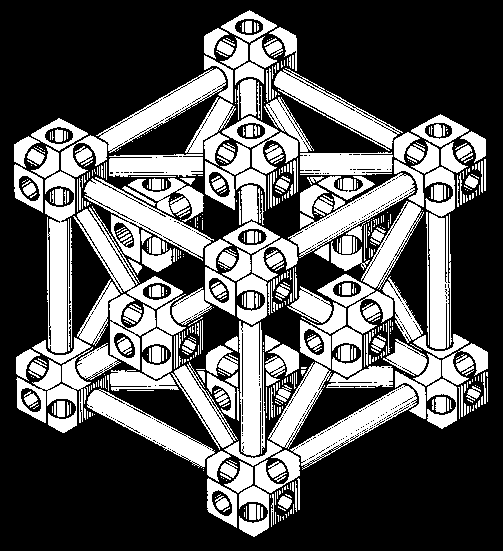
A most interesting variation is to use edge-beveled cubic blocks with 12
additional holes, as shown in Fig. 187. Many intriguing non-orthogonal geodesic
constructions can be made with a set of these. The dowel lengths will be in
multiples of  .
.
Fig. 187
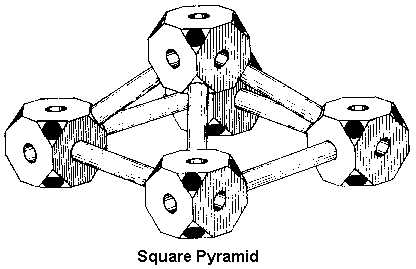
Another interesting variation is provided by the truncated cube (or truncated
octahedron) with its eight additional holes. These will employ dowels having
lengths in the ratio of  ,
as in Fig. 188.
,
as in Fig. 188.
Fig. 188
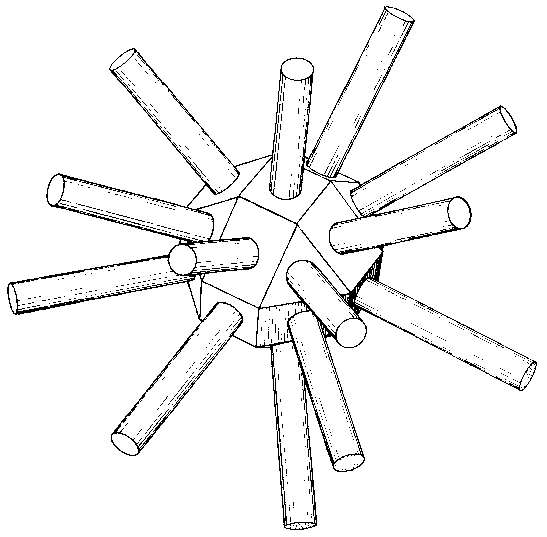
Finally, one might combine all of the above into a super-set of blocks, with all or some of the blocks having all 26 holes, together with dowels in all the appropriate lengths. One such block is shown in Fig. 189.
Fig. 189 Showing the 13 axes of cubic symmetry
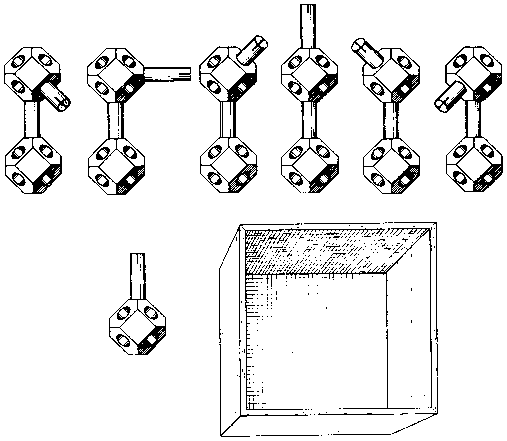
Simply constructing geometrical forms with such a set of blocks and dowels can be entertaining and educational, with or without illustrations as a guide. They also have potential for puzzle problems. The seven pieces shown in Fig. 190 comprise all the ways that one block and one dowel or two blocks and two dowels can be joined, using 12-hole blocks. Can they be assembled to fit snugly into the cubic box? What other symmetrical forms will they construct?
Fig. 190
All of the sets described thus far employ radial holes - that is, with their axes all intersecting each other at the solid center of the block. There is another family of designs in which none of the hole axes intersect. The holes can be drilled straight through and the dowels can be of indefinite length. The holes will be sized for the dowels to slide freely through.
This family can be further divided into two sub-families depending upon whether the drilled components are discrete blocks or uniform sticks of indefinite length. Examples of the latter have already been shown in Chapters 6, 13, and 17.
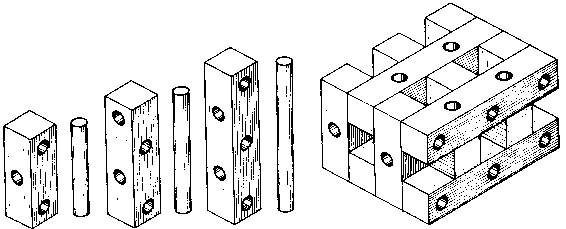
One further variation of the Pin-Hole Puzzle is shown in Fig. 191. The square sticks have holes equally spaced and arranged alternately. The assembly of sticks and dowels forms an orthogonal lattice that can extend indefinitely in all directions.
Fig. 191
A set of such pieces might make a simple assembly plaything, perhaps to be fitted into a rectangular box. Or, with ingenuity, the idea might be developed into some sort of puzzle set. Incidentally, this entire chapter was conceived, developed, and rushed to the publisher just in time for inclusion, so many of these ideas are still "in the rough". (Are they not sometimes better that way?)
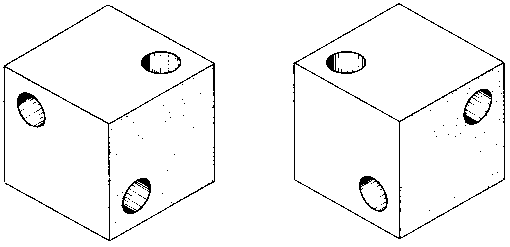
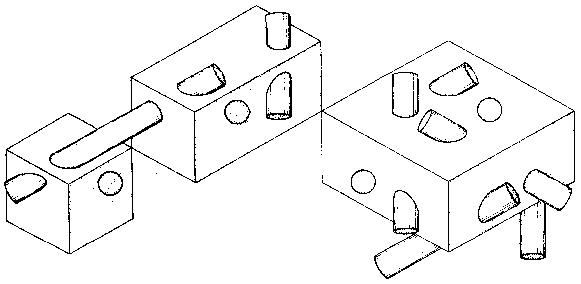
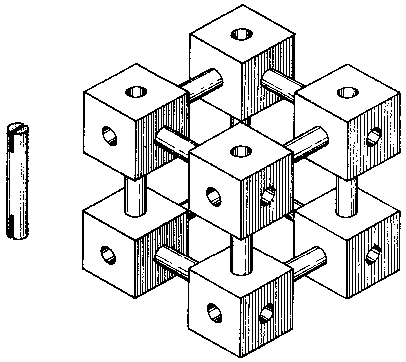
A cubic block with three mutually perpendicular non-intersecting holes drilled through it is shown in Fig. 192. It has a reflexive pair of forms.
Fig. 192
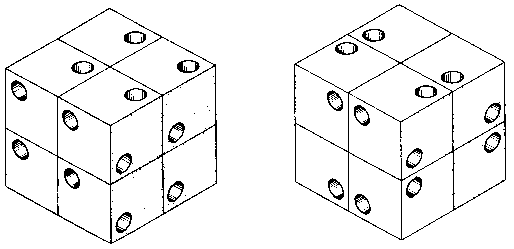
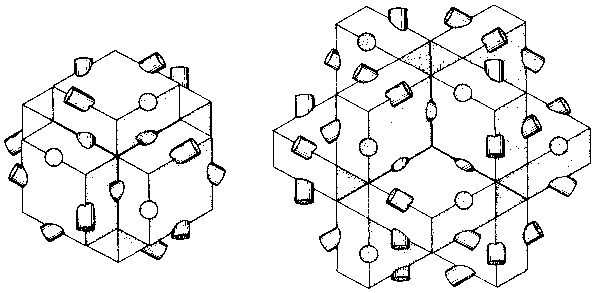
An assembly of such blocks and dowels can be extended indefinitely. In the model shown in Fig. 193 on the left, all the blocks are identical. In the one on the right, the blocks alternate right-handed and left-handed. Note the two different types of symmetry that result. Only the assembly on the right can be said to have isometric symmetry as defined in Chapter 6.
Fig. 193
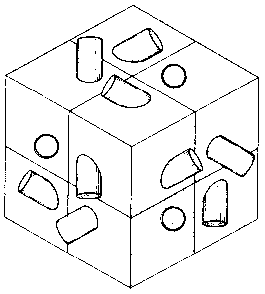
Now consider the following problem: again start with a 2 x 2 x 2 assembly of cubic blocks. Again drill three holes through each block so that 12 dowels can be inserted through the pile. But this time, all eight of the drilled blocks must be identical and the assembly must have isometric symmetry. The solution is shown in Fig. 194.
Fig. 194
The three identical holes in each block are all parallel to internal diagonals of the cube, and their axes exit the faces exactly one-third the distance from both edges. To be entirely satisfactory, the holes must be drilled accurately, and this will require a suitable jig set-up plus some patience to get it adjusted properly.
This is likewise an omnidirectional construction capable of infinite expansion in all directions. It has many fascinating variations. The 2 x 2 x 2 grouping can in itself become a unit building block with 12 holes, or it could be broken into rectangular sub-units, as shown in Fig. 195.
Fig. 195
The puzzling possibilities here would appear to be practically limitless. One interesting variation uses 1 x 2 x 2 rectangular blocks. The four symmetrically arranged holes in each block pass diagonally through midpoints of sides. The blocks do not pack together but rather leave cubic and rectangular spaces. Neat symmetrical assemblies of six and twelve blocks are shown in Fig. 196.
Fig. 196
A large set of such blocks and dowels is in itself fun to tinker with, but if some of the dowels and blocks are joined permanently and assembly problems are devised around them, they become intriguing puzzles as well.
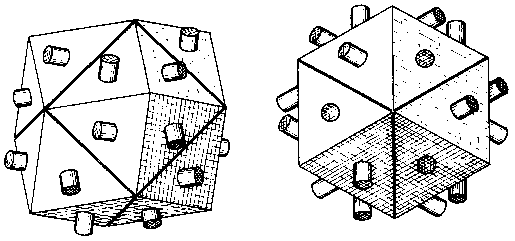
In yet another variation, shown in Fig. 197 in two different views, squat octahedra have been substituted for the rectangular blocks above. Six of these are shown assembled with 12 dowels to form a solid rhombic dodecahedron. This construction is space-filling. Note that in the view along the threefold axis, the holes are centered in equilateral triangles.
Fig. 197
Since the intriguing geometry of the rhombic dodecahedron is the basis for so many of the designs described in this book, combining it with our natural inclination for sticking pins into holes and joining things together should lead to many interesting new recreations.
By now, it should be clear that few, if any, of the designs described could be considered novel inspirations except in some small part. They all are logical offspring of previously established geometrical families, legitimate or otherwise. Mathematically speaking, the role played by the designer is often almost trivial. Once you start exploring this puzzling world of polyhedral dissections, one idea just leads to the next. Their arrangement in this work is an attempt to place the ideas in logical sequence of lineage. The problem is that one idea may have several roots branching backward in different directions. Often, one can arrive at the same place by two entirely different routes. Here is a good example:
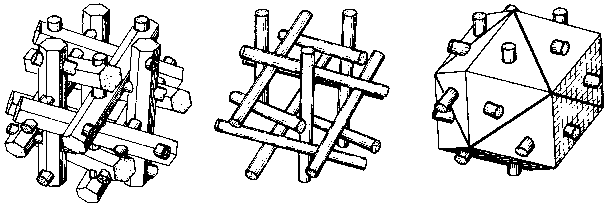
Recall from Chapter 13 the arrangement of 12 hexagonal sticks and dowels, shown on the left in Fig. 198. Now imagine that instead of the hexagonal sticks, all of the space surrounding the dowels is filled solid. Tessellate that space into space-filling rhombic dodecahedra, and dissect the central rhombic dodecahedron into six squat octahedra, shown in Fig. 198 on the right. The result is exactly the same as the design shown in Fig. 197.
Fig. 198
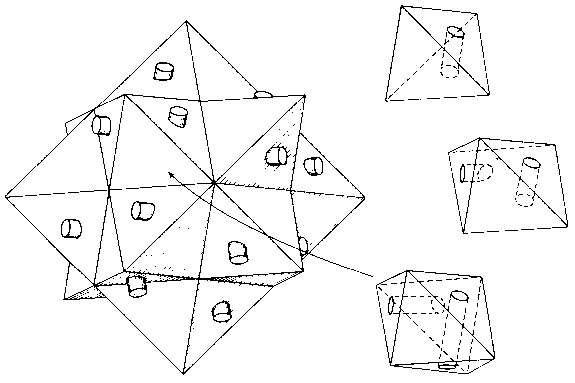
The construction described above suggests compellingly by analogy dissection of other polyhedra into sections held together with dowels. Shown in Fig. 199 is a stellated rhombic dodecahedron with 12 dowels drilled through it. There are many different practical ways that this solid might be dissected, such as into 48 tetrahedral blocks, 24 rhomboid pyramids, or 12 double rhomboid pyramids, as shown.
Fig. 199
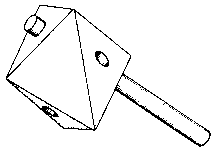
Now compare the double rhomboid pyramid above with the squat octahedron of the previous design and note that they are the same geometrical solid with the same hole locations, the only difference being in the number of holes. Thus, a set of 12 four-hole blocks and dowels constructs two rhombic dodecahedra or one stellated version. If several of the dowels are fastened in place to form lollipop pieces (Fig. 200), assembly of these figures becomes an entertaining puzzle. What is the maximum number that may be joined and still be possible to assemble?
Fig. 200
These blocks are fairly easy to saw from square stock, as explained in Chapters 8 and 9. A simple jig set-up can be used for the repetitive drilling of the holes. Since the holes are quite tilted toward the surface, a sharp spur point and soft wood are recommended to prevent wandering of the bit.
The Lollipop Puzzle
Drawing on the Brain
| ©1990-2005 by Stewart T. Coffin For questions or comments regarding this site, contact the chief metagrobologist:  |
[Next Page] [Prev Page] [ Next Chapter] [Prev Chapter]