 |
 |
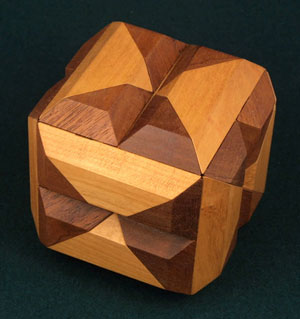 |
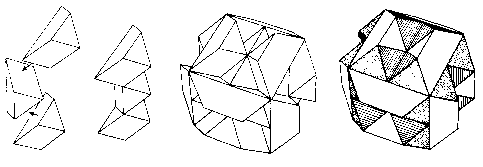
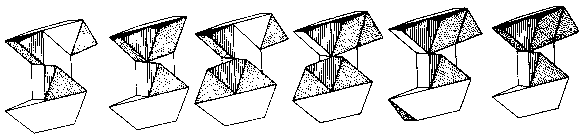
| Fig. 115 |
[Home] [Contents] [Figures] [Search] [Help]
[Next Page] [Prev Page] [ Next Chapter] [Prev Chapter]
Often two polyhedral dissections may be internally similar and functionally identical as assembly puzzles, even though their external appearances are quite dissimilar. Here is a good example.
The single puzzle piece shown in Fig. 115 consists of three six-sided center blocks joined together. Six such identical pieces assemble into an interlocking configuration as shown, with three gaps in each of the eight corners. These gaps are filled with 24 rhombic pyramid blocks attached in such a fashion that six dissimilar non-symmetrical puzzle pieces are created. The six sides of the assembled puzzle are then truncated into square faces, making it cubic. The sliding axis for the first step of disassembly is an internal diagonal of the cube and can be rather tricky to locate. Thus, this puzzle is entertaining both to solve and to disassemble. It is also quite attractive in two contrasting woods, with the six faces sanded and polished.
| ©1990-2005 by Stewart T. Coffin For questions or comments regarding this site, contact the chief metagrobologist:  |
[Next Page] [Prev Page] [ Next Chapter] [Prev Chapter]