 |
 |
 |
|
| Fig. 116 | |
[Home] [Contents] [Figures] [Search] [Help]
[Next Page] [Prev Page] [ Next Chapter] [Prev Chapter]
If the Diagonal Cube Puzzle is incidentally tricky to disassemble, this theme is carried one step further in the next example, which is made deliberately so.
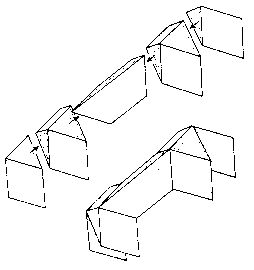
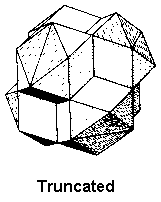
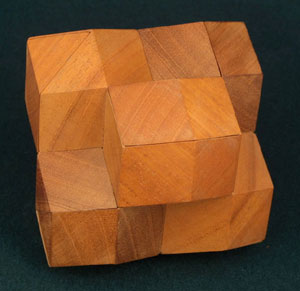
Each puzzle piece consists of a six-sided center block, to each end of which is attached another six-sided center block and a prism block. In the version shown in Fig. 116, a right-handed prism block is at one end and a left-handed one at the other end, so that each piece has reflexive symmetry and all six pieces are identical. (Other more complicated versions are possible having dissimilar pieces.) The puzzle is assembled with no great difficulty by mating two mirror-image halves to form an interesting polyhedral shape having the appearance of a cluster of six rhombic dodecahedra. To disassemble it, however, three fingers of each hand must be placed in exactly the correct places and pushed in opposition to start the two halves apart along their one sliding axis. Even when made slightly loose so that it rattles in one's hands, random poking and prying will seldom dislodge the two halves. A truncated version is also shown.
| ©1990-2005 by Stewart T. Coffin For questions or comments regarding this site, contact the chief metagrobologist:  |
[Next Page] [Prev Page] [ Next Chapter] [Prev Chapter]