[Home] [Contents] [Figures] [Search] [Help]
[Next Page] [Prev Page] [ Next Chapter] [Prev Chapter]
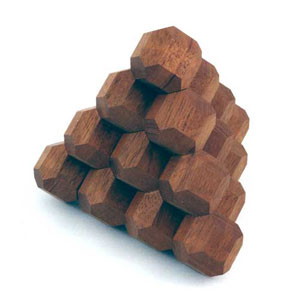
Most polyhedral block puzzles are non-interlocking, including the Truncated Octahedra Puzzle and Leftover Block Puzzle previously described. All things considered, interlocking puzzles usually have more appeal. The problem here is one of complexity. For example, most practical, interlocking cubic-block puzzles require at least 64 blocks. The numbers of R-D blocks in triangular pyramidal piles are given by the following series: 4,10, 20, 35, 56, 84, ... which is the smallest of these that can be dissected into a practical interlocking puzzle? Surprisingly, the 20-block tetrahedral pile of rhombic dodecahedra can be dissected into four puzzle pieces of five blocks each that are not only interlocking but also dissimilar and non-symmetrical and assemblable in one order only. Knowing this, it is not very difficult to discover the design, so that recreation is left for the reader to enjoy. The one known design shown in Fig. 171 is believed to be unique but has not been proven so.
Fig. 171
| ©1990-2005 by Stewart T. Coffin For questions or comments regarding this site, contact the chief metagrobologist:  |
[Next Page] [Prev Page] [ Next Chapter] [Prev Chapter]