[Home] [Contents] [Figures] [Search] [Help]
[Next Page] [Prev Page] [ Next Chapter] [Prev Chapter]
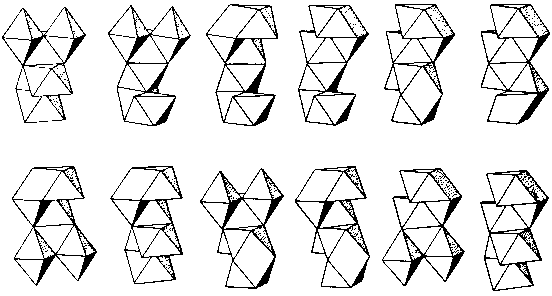
Recall the simple two-piece dissection of the rhombic dodecahedron shown in Fig. 147. These half-pieces can be joined in pairs in different ways to form puzzle pieces. Excluding those that are impossible to assemble or have an axis of symmetry, there are 12 such pieces, shown in Fig. 175.
Fig. 175
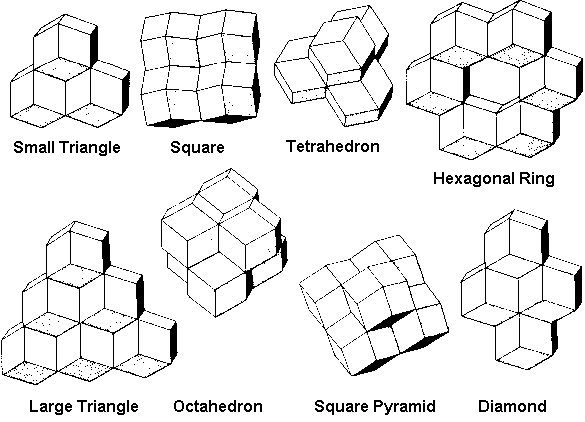
Let us make a list of possible constructions, i.e. ways that R-D blocks can be clustered symmetrically. To keep things simple, consider only those with six or fewer blocks. Eight such figures are shown in Fig. 176a.
Fig. 176a
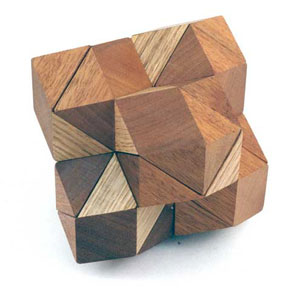
Editor's Note: Stewart named this puzzle The Peanut Puzzle.
Fig. 176b
Now for the interesting part. Can you find a subset of six pieces from the set of 12 that will construct all eight of the above figures? Do not be too discouraged if not, because Beeler's computer could not either. Of the 924 possible such subsets, there is one, however, that will construct seven of the eight figures. Find it if you can, keeping in mind that the seeking may be more fun than the actual finding.
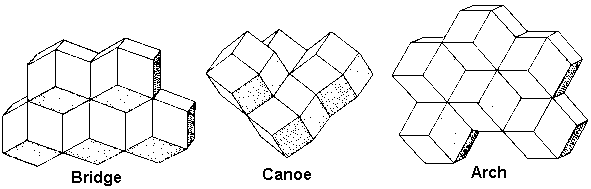
Considering the thousands of different possible subsets of puzzle pieces and the many interesting constructions possible with any of them, the recreational potential for this family of puzzles is vast and practically unexplored. Choose your own personal subset of puzzle pieces and compile your own library of geometrical or animated shapes that they will construct (see Fig. 177). The pieces are also great fun just to doodle with. Any closed loop can be considered a solution of sorts.
Fig. 177
A well-crafted set of these pieces makes a most satisfactory puzzle. Each half of each puzzle piece is made of three squat octahedra building blocks joined accurately together, and the full pieces are then made up of these half-pieces joined different ways.
(Incidentally, to digress slightly, a fascinating recreation is to determine how many of the eight constructions shown in Fig. 176 are space-filling. You may be surprised at the answer.)
| ©1990-2005 by Stewart T. Coffin For questions or comments regarding this site, contact the chief metagrobologist:  |
[Next Page] [Prev Page] [ Next Chapter] [Prev Chapter]