[Home] [Contents] [Figures] [Search] [Help]
[Next Page] [Prev Page] [ Next Chapter] [Prev Chapter]
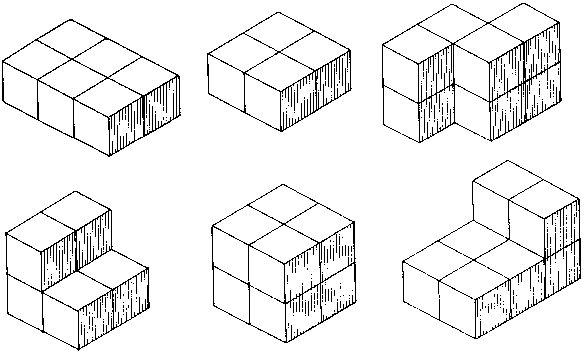
The Six-Part Invention design leads by analogy to one based on cubes in place of rhombic dodecahedra, dissected the same way. These half-pieces can be joined in pairs eight different ways, as illustrated in Fig. 178.
Fig. 178
The obvious question is whether these eight pieces can be assembled into a cube. That they do, and much more. Here is one of the best examples in this book of a geometrical recreation that lends itself to use in the classroom. For example:
| 1. | Using two disconnected half-pieces, find all the ways that they can be joined face-to-face. You will of course arrive at the set of eight pieces, but this simple exercise can be quite instructive. |
| 2. | Prove that four pieces are the fewest that can be connected together in a closed loop. Prove that the square is the only such possible figure. Can two separate squares be made using all eight pieces? Why not? |
| 3. | Prove that the 2 x 4 rectangle is impossible. (Problems of this sort can always be solved systematically by trying every piece in every possible combination, but look for shorter and more elegant proofs using logic. Now what other shapes cannot be made for the same reason? |
| 4. | Assuming all solutions to be closed loops, prove that an even number of pieces must always be used. Find all possible solutions using six pieces. Likewise using all eight pieces. Examples are shown in Fig. 179a. |
Fig. 179a
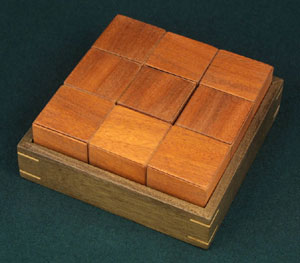
Editor's Note: Stewart named this puzzle Pieces of Eight.
Fig. 179b
Six of the pieces have reflexive symmetry and the other two are a reflexive pair. It necessarily follows that every solution must either be self-reflexive or occur in reflexive pairs. (These pairs are not counted as separate solutions.) Can you figure out why?
Some of the most fundamental questions in physics have to do with symmetry, and perhaps this puzzle will stimulate the student's interest in this fascinating subject. If the most elementary particles in the universe and all of the laws governing them were symmetrical (which is not to say they are), would it not follow that everything made from them, from atoms to the entire universe, should be either self-reflexive or one of a possible reflexive pair? But therein lies a curious paradox. Imagine that in the next instant the universe switched to its mirror image. How could you tell? Would not human consciousness be reflexive also? (Whatever that means!)
Another strange case is the DNA molecule and the genetic code. Most of us are right-handed, nearly all of us have our appendix on the right, and all of us carry DNA with a right-handed twist. How are instructions for right-handedness carried genetically? Would an identical but reflected DNA molecule produce an identical but reflected organism? A lucid discussion of these and many other fascinating problems in symmetry may be found in the Ambidextrous Universe by Martin Gardner, but don't expect to find all the answers.
The half-pieces for the Eight-Piece Cube Puzzle are made from three square pyramid blocks joined together. These blocks are made from sticks of isosceles-right-triangular cross-section with two 45-degree cuts. For experimental work, the mating joints can be slightly on the loose side. A more accurate model of this puzzle made of fine woods with close-fitting joints is a delight to play with. The sharp edges may be beveled or rounded slightly to give its stark Bauhausian functionality a little more softness and warmth.
| ©1990-2005 by Stewart T. Coffin For questions or comments regarding this site, contact the chief metagrobologist:  |
[Next Page] [Prev Page] [ Next Chapter] [Prev Chapter]